
Interview
Foundation models of life and medical science project
Foundation models in materials science project
Common Infrastructure and Technology project
“AI for Science” supercomputing platform project
Report
What if an AI won a Nobel Prize?

How far can science go in understanding the world? Only a small part of nature can be described from laws with paper and pencil. Life, matter, the environment, and society: many of the systems we confront are complex systems, nonlinear, multilayered, and tightly entangled. Faced with such complexity, the traditional methods of science are quietly approaching their limits. Science is now entering a phase in which the issue is no longer merely faster computation or greater automation, but the very way hypotheses are formed, understanding is achieved, and even who, or what, counts as the agent of science.
Complexity: the limits of human science
My own background is in physics. Broadly speaking, physics has two major directions. One seeks to push deeper into fundamental laws, such as those represented by elementary particle physics. The other asks why such diverse and complex phenomena emerge in the world from those basic laws. I have long been interested in the latter question: how complex entities, including living systems, come into being.
But once complexity itself becomes the object of study, the traditional modes of theoretical understanding quickly reveal their limits. Problems that can be solved elegantly with paper and pencil make up only a small fraction of nature. Many nonlinear phenomena, shaped by intertwined interactions, cannot be solved analytically. One must rely either on simulation or on building models directly from data. My own work has long centered on simulation, but the situation has begun to change markedly in recent years.
The effort underway at AGIS to accelerate science with artificial intelligence, often described as AI for Science, is based on this shift. AI for Science is not only for improving research efficiency: faster calculations, automated experiments and the like. What is more important is that AI is beginning to accelerate the core processes of science itself, such as hypothesis generation and model building.
How data changes science
In scientific research so far, hypotheses have depended heavily on the experience and intuition of human experts. Experiments, theory, simulation, and observation have been made to gradually open up unknown territories of knowledge. That back-and-forth cycle has been one of the basic structures of science.
AI introduces an entirely different element into that structure. It can handle vast amounts of data across domains, extract high-dimensional patterns that humans cannot grasp all at once, and produce abstractions that cut across fields. These capabilities raise the possibility that AI could suggest hypotheses that do not simply extend human experience or intuition.
A striking example is AlphaFold, an AI system for protein structure prediction. AlphaFold made it possible to infer three-dimensional protein structures with high accuracy, a process that had long depended heavily on experimental methods. AlphaFold emerged not only because machine-learning methods improved, but also because protein structure data had accumulated over many years. Even if today’s machine-learning techniques had existed 20 years ago, the available data at the time would probably not have supported the same achievement.
In AI for Science, the way data is acquired and accumulated is therefore a decisive factor in determining whether research succeeds. That, in turn, makes the automation of experiments and observations, including robotic systems for data generation, indispensable. One of AGIS’s major goals is to build foundation models for science. But in parallel, we are also working across experimental science, life science, materials science, computation, and robotics to integrate AI and automation into the research process as a whole.
The scientist of the future will be a human-AI hybrid
One of the central challenges in AI for Science is to redefine the agent of science. Traditionally, that role has been occupied by the human scientist. AI was a tool, no more than an auxiliary presence. But as AI becomes more deeply involved in generating hypotheses and constructing models, the agent of science will shift from the human alone to a composite of human and AI.
This does not mean that scientists will become unnecessary. Decisions about what questions are worth asking, where value lies, how to interpret the outputs produced by AI, and how to position them in society will place even greater demands on human judgement.
The scientist’s task is likely to be reshaped with the advancement of AI. Scientists will spend less of their time manually operating apparatus and more of it designing research as a whole. Structuring the question, determining which parts AI should handle, and deciding where human judgement must intervene will become the central scientific work.
Science as an experimental site of transformation
Consider a thought experiment. An AI makes a discovery worthy of a Nobel Prize. The discovery might help to overcome a wide range of problems in the world. But what should we do if there is no explanation at all of what the discovery is or how it works?
AI is especially powerful in domains that deal with highly complex systems. Biological phenomena, cellular responses, the self-organization of materials, and nonlinear chemical-reaction networks are all extremely difficult to understand theoretically, and have therefore relied heavily on simulation. But we are now entering a stage in which, given sufficient data, AI can build predictive models directly. This unsettles the traditional process in science, in which one first understands a complex target and then models it.
AlphaFold is perhaps the clearest example. In protein structure prediction, if the mapping between input and output can be learned with sufficient accuracy, the model can still be practically useful even if its internal mechanisms are not intuitively understandable to humans. A functional model can exist even when its causal logic cannot be written down explicitly.
This forces human scientists to confront deeper questions: what counts as understanding, and what counts as explanation? How much explainability should be demanded? At what point should successful prediction be regarded as scientific understanding? The answers to these questions are not self-evident. They are what we must now begin to explore.
Explainability is also tied to the social legitimacy of AI. The principles that have long guided science, such as reproducibility, transparency, and accountability, do not necessarily align with black box hypothesis generation by AI. This is one of the social challenges that AI for Science is likely to face in the near future. That is why AGIS places emphasis not only on model development but also on experimental infrastructure, including robotics and automation. We aim to acquire data, record experimental conditions systematically, and improve reproducibility as far as possible without dependence on manual work. The opacity of AI should be counterbalanced with rigorous experimentation.
The goal of AGIS is not to force science into a closed loop of automation. It is to create a new and open ecosystem of knowledge in which AI, supercomputers such as Fugaku, robotics, and human scientists all interact and shape one another. In such an ecosystem, the value of science cannot be measured simply by efficiency or productivity. Alongside the pursuit of truth, one must also ask what kind of value science brings to society.
As scientists, we stand at a turning point in this larger transformation. We must ask again what science is, what understanding is, and how both should be remade. AGIS is a leading-edge organization that has chosen to take on that challenge and that responsibility. It is a place where change happens.
What AI can do, and what it cannot.

AI for Science is sometimes described as though it could sweep across the whole of science. But from the vantage point of actual research practice, it becomes clear that many areas remain beyond AI’s easy reach. Research on polymer materials, in particular, is one of the fields that most sharply exposes AI’s limits, because it combines an effectively unbounded search space with a scarcity of usable data. What can AI do, and what can it not do? Looking from that boundary may help us think more clearly about how science should proceed in the years ahead.
The problem that comes before AI
At AGIS, AI for Science is often discussed in terms such as accelerating scientific research or automating the research process. But before we even stand at that entrance, I believe we need to ask a different question first. How prepared is scientific research itself for AI intervention?
My own work has been in materials science, especially polymeric materials. These materials, including plastics, rubber, and fibers, are used throughout society and industry. Yet from the perspective of data-driven research with AI, this is a field that remains markedly underdeveloped. Put simply, it is a field in which data does not yet exist in sufficient quantity or in forms suitable for the assumptions on which AI depends.
Polymer materials offer enormous freedom in chemical structure, and the processes of synthesis and evaluation often involve many stages. As a result, each experiment is costly, and the data that is obtained tends to remain fragmented across laboratories. Under these conditions, a culture of sharing data and accumulating it openly across the field has scarcely developed.
AI does not function without data. This is not a matter of technological immaturity but a fundamental constraint. In fields where AI has produced striking results, such as shogi, Go, or protein structure prediction exemplified by AlphaFold, there were already vast data infrastructures built up and shared over many years. Research on polymer materials is a field that has lacked those conditions from the outset.
The framework I have proposed, polymeromics, is an attempt to change this situation. Rather than trying to understand polymer materials one by one as isolated cases, polymeromics aims to treat structure, synthesis conditions, physical properties, and function in an integrated way, so that these materials can be understood systematically and comprehensively.
In practice, this means carrying out large-scale simulations that reproduce the properties of polymer materials in silico and organizing the results into a systematic database. It also means using experimental robots to automate real-world synthesis and evaluation, thereby generating experimental data continuously. By linking that data with computational results, the goal is to accumulate knowledge in forms that AI can use.
In the field of life sciences, genomics and proteomics have generated new insights by enabling researchers to work across vast bodies of molecular information. The same kind of readiness, the ability to handle a field comprehensively, will be essential in the world of polymer materials. Polymeromics is an effort to build that foundation.
The problem of scale in AI-driven science
As I have worked on polymeromics, I have repeatedly encountered a series of challenges that lie between AI-driven science and more traditional scientific practice. I have tried not to treat them simply as defects, but rather as problems that will inevitably surface and therefore should be confronted early.
One of them is the problem of scale. By scale, I mean our sense of how much data, and how many trials, are required before scientifically meaningful discussion or prediction becomes possible.
In conventional experimental science on polymer materials, studies based on tens to hundreds of data points have often been sufficient for hypothesis testing and theory building. Researchers have read trends from limited data and used them to guide the next experiment or the next theoretical step. That sense of scale has shaped the development of the field.
But once the goal becomes to build general predictive models with AI, the premise changes substantially. Machine learning is not primarily a method for understanding individual cases. It is a method for learning the statistical structure embedded in data as a whole. For that reason, stable performance often requires at least hundreds of thousands of data points, and in some cases millions. In the longer term, one must even consider data sets on the scale of billions or tens of billions. That is not an exaggeration; it is a realistic requirement implied by the statistical character of current machine-learning methods.
Such a difference in scale, a difference of orders of magnitude, may produce a deep discontinuity between researchers’ intuitions and existing research systems. It is often assumed that once automated experimental platforms or robots are introduced, large quantities of data will follow naturally. In reality, things are not so simple. In many cases, even automated experiments produce only tens to hundreds of data points. Automation alone does not bring research to the scale that AI assumes.
So how can research move towards a scale that is meaningful for AI? What matters is not simply the apparatus itself, but a fundamental rethinking of experimental design. Which conditions should be explored, and over what range? Which properties should be prioritized for measurement? Decisions of that kind strongly shape both the quantity and the quality of the data that emerges.
This is not something that can be reduced to straightforward automation. It remains an area in which researchers’ experience and judgement are deeply involved. Indeed, it may be better understood as a domain in which the real question is how to combine human insight with AI’s computational power.
The work at AGIS is also a process of trial and error aimed at addressing these issues. The challenge is how to move from established research cultures and methodologies towards forms of research adapted to the age of AI, while still respecting what came before. Can a field remain sustainable while continuing to generate data that is scientifically meaningful over time? I believe that continuing to confront that question is one of AGIS’s central roles.
Doing science together in the places AI cannot reach
In research on polymer materials, the space of materials to be explored is, for all practical purposes, effectively infinite. No matter how advanced computational resources or experimental platforms become, there will be no day, at least not within the next several decades, when that space is filled in with data. In that sense, polymer materials research contains many regions that AI cannot readily reach.
The essence of science lies in exploring the unknown, in entering territory that has not yet been charted. And because that territory is unexplored, no prepared data exists there in advance. Without data, AI cannot intervene directly. This limitation is unlikely to disappear in any essential way, no matter how much the technology advances. AI is good at learning patterns from existing data. It cannot, by itself, step into places where no data yet exists.
As a result, the sciences in which AI is easiest to deploy may become skewed towards domains where data is relatively abundant. That risks introducing a bias into how science itself is pursued. For that reason too, AI for Science should not begin from the assumption that AI will solve everything.
What matters more is to start by recognizing that there will always be domains beyond AI’s reach, and then to design the division of labor between human researchers and AI accordingly. How far should tasks be entrusted to AI, and where must humans take over? Deliberately reconsidering that boundary is likely to become one of the defining demands of scientific research in the future.
In that sense, the idea of foundation models, as advanced at AGIS, is important because it asks how far human exploration can be supported while taking AI’s limits seriously. The idea is to prepare models that learn general knowledge from very large data sets, and then adapt them to specific domains in which only relatively small amounts of data can be obtained. This can be understood as an attempt to build a bridge into data-sparse areas that lie beyond AI’s easy reach.
I do not think AGIS’s role is to present a single correct answer to AI for Science. The issues involved, data, computation, experimentation, and even research institutions and research culture, are deeply entangled. What matters most is that AGIS serves as a place to test, one by one in real research settings, where to begin, and how to proceed.
AI takes nothing away from science

Twentieth-century science built powerful theories to explain the world, but in doing so it also revealed the limits of human understanding. AI for Science is an attempt to push beyond some of those limits with artificial intelligence. But it does not take anything away from science. Rather, it works alongside human science and helps to move it forward.
Tackling science’s unresolved problems
Twentieth-century science produced many powerful theoretical tools for understanding nature. Relativity, quantum mechanics, and statistical mechanics made it possible to describe phenomena that appear intuitively complex in the language of mathematics, turning them into objects that could be predicted and controlled. These theories achieved many of their successes in what are known as equilibrium systems, systems in which interactions with the outside world are limited and the state does not change dramatically over time.
An equilibrium system is, for example, a system in a stable condition, such as a sealed container that has been left long enough for temperature and pressure to become uniform throughout. In such systems, the behavior of many components can be averaged, allowing the whole to be expressed in terms of a small number of variables. That, in turn, made it possible to draw relatively clear correspondences between theory and experiment.
But there were also domains that twentieth-century science could not fully address. These are the classes of problems broadly described as non-equilibrium systems and complex systems. Non-equilibrium systems are those in which energy or matter flows in and out, so that the state of the system continues to change. Living systems are a typical example. So too are climate change, brain activity, and social systems. These are also often described as complex systems.
In such systems, the difficulty is not only that they contain a vast number of components, in other words, a very large number of degrees of freedom. It is also that the components do not behave uniformly. Individual elements possess different states and histories, their own “individuality,” and the behavior of the whole emerges from the accumulation of their interactions. Simply averaging the behavior of cells, or of people, is not enough to explain the dynamics of life or society.
For that reason, simple averaging and approximation are much less effective in non-equilibrium systems, and the boundary conditions are not easily defined. The number of variables needed to represent the state of the system grows explosively, making it difficult to capture such systems in compact mathematical expressions of the kind that human cognition can readily handle. These high-dimensional, non-equilibrium systems are among the unresolved problems that twentieth-century science has handed on to the next generation.
This is precisely where AI for Science is likely to have its greatest impact. That does not mean AI is all-powerful or capable of solving every problem that has resisted previous approaches. What matters is that computational tools have finally become available at realistic scales that can handle many variables at once and model complex correlations while losing as little information as possible.
Nor is AI something that replaces existing mathematics or theory. AI does not take anything away from science. Instead, it is beginning to provide a new foothold in areas that previous theory and computation could not easily reach.
AI as the automation of intellectual labor
The phrase AI for Science often leads people to imagine a technology that will replace scientists themselves. That may be one aspect of it. But more importantly, it is also an attempt to define a new form of science, one that can enter domains that have resisted formalization and systematization.
Looking back at the twentieth century, the Industrial Revolution was above all a set of technologies for automating human physical labor. Steam engines and mechanization removed constraints on human strength and speed and dramatically expanded the scale and pace of production. In a similar way, AI in the twenty-first century may eventually come to be seen as a technology for automating intellectual labor. By intellectual labor, I mean not only tasks such as judgement, search and optimization, which contain some degree of regularity and repetition, but also thought processes in which creativity itself is at stake, such as the generation of new hypotheses.
What is the most concentrated site of creative trial and error in human activity? Alongside art, it is surely scientific research. For that reason, science is one of the fields most likely to adopt this new technology at the leading edge, to be transformed by it, and to benefit from it most deeply.
The essence of science lies where data is produced
Modern AI depends heavily on data and computational resources. That structure helps explain why large technology companies, which can collect vast amounts of information from the Internet and use it for training, have gained such a strong advantage.
But when thinking about AI for Science, one must remember that data is not only something that already exists. It must also be made. In experimental science, data typically comes into being only through carefully designed protocols of experiment and observation. By protocol here I mean the entire set of arrangements that define an experiment, including the conditions, measurement procedures, instruments, and treatment of error.
In that sense, the essence of science in AI for Science lies at the site where data is produced. What matters is not only the quantity or format of the data, but also the setting in which it was generated and the procedures through which it came into being.
At RIKEN, for example, advanced experimental techniques have been accumulated over many years, including organoid production, materials synthesis, and precise physical measurement, methods that can only be carried out in specific laboratory environments. These protocols are not merely difficult to reproduce. They are deeply embedded with researchers’ judgement and skilled practice, and can only be generated in advanced research settings.
If such experimental processes can be automated and linked with computation, then it may become possible to generate forms of scientific knowledge that AI companies alone could not easily reproduce.
The version of AI for Science envisioned at AGIS also differs from AI whose main purpose is to train on large volumes of pre-existing data. Its distinctive feature is that it does not stop at asking what can be learned from available data, but also asks what data should be generated next, and intervenes in that process. This approach is generally known as active learning. In active learning, AI proposes the next experimental conditions to test on the basis of hypotheses or uncertainty, automated systems such as robots carry them out, and the results are then fed back into the learning process.
What is being learned here is not only a static body of accumulated data. The very process through which data continues to be generated becomes part of learning itself. Put differently, the methodology of scientific research itself is being updated together with AI.
In this cycle, leadership does not necessarily belong to the model with the largest scale or the highest numerical accuracy. What matters is the ability to design and stably operate the setting in which particular kinds of data can be generated under particular conditions. That is why we are placing such emphasis on building autonomous robotic laboratories.
Humans still need human science
So what kind of science comes after AI for Science? Our world is an extraordinarily complex system made up of countless interacting elementary particles, unfolding across time and distance far outside ordinary human intuition. The human brain and senses have been shaped over hundreds of millions of years of biological evolution to help us survive in everyday life. Evolution did not require us to intuitively grasp timescales such as nanoseconds (one billionth of a second) or distances such as parsecs (about 3.26 light years). There is therefore no guarantee that our brains are naturally equipped to understand the objects studied by the natural sciences, whose history is only a few hundred years old.
And yet we try to simplify the world using expressions such as mathematics, language, and models, compressing it into forms of explanation that we can accept as intelligible. That activity is science. Science is what happens when human beings, with human bodies and brains, try to understand this complex world. If the human being is removed as the agent of science, there may still be mathematics, but there is no longer science. If that were not so, then the most complete understanding of the universe would simply be a full listing of the positions and states of all the elementary particles that compose it. But that is not how we ordinarily think. Science is the process of compressing information, through the human body and brain, into theories, equations and papers that human beings can understand.
At the same time, once one begins to think seriously about AI for Science, it becomes possible to imagine a future in which human science and AI science diverge. I have argued that understanding cannot exist without assuming a finite body and a finite cognitive structure. That is true for AI as well. Humans and AI process information in very different ways. If so, then some divergence between human scientific understanding and the kind of “scientific understanding” AI develops in order to improve its own performance may, in a sense, be inevitable.
Would such a divergence necessarily be a problem for human science? There will be many ways of thinking about that question, but I suspect it marks a major fork in the road for the future of science. At AGIS, we want to think about that divergence positively. In the long run, I believe the tension between human science and “AI science” could expand, rather than diminish, the possibilities of human science.
Building the foundations of a new science through computation

Scientific research is now at a major turning point. Advances in computing power and artificial intelligence are beginning to change the way research itself is conducted. The AI for Science effort at AGIS aims to redesign computational resources and AI as the foundations of a new kind of scientific research.
The divide in AI access is becoming a divide in scientific capability
AGIS’s mission under AI for Science is to change the situation in which only a limited number of researchers can make full use of AI, and instead to build it as an open research infrastructure. Put differently, the aim is to reinvent scientific research through AI.
We often speak of accelerating science. By that, we mean shortening the research cycle and increasing the number of innovations that can be reached. Attempts to accelerate science have of course been made before, through larger research budgets and greater investment in talent. But we have already entered an era in which those measures alone are no longer enough. Today, the keys to accelerating science are computational resources and AI.
Scientific progress can no longer be sustained solely by isolated achievements from a few exceptional researchers. Hypotheses are generated, tested, revised, and connected to the next question. When sufficient computational resources are allocated to that iterative process, and when AI, simulation, and automated labs are deeply integrated into it, science can begin to move beyond the limits imposed by the speed of human thought and the scale of human labor. We are approaching a point at which science can no longer be accelerated without such a foundation.
Already, disparities in access to AI are beginning to create an invisible divide in research practice. In the United States and Europe, the construction of research infrastructure built around the use of AI is advancing as a matter of national strategy, and research styles in which AI supports everything from hypothesis generation to experimental design and data analysis are spreading rapidly. Access to sufficient computational resources and AI changes the number of research cycles that can be run, and this produces decisive differences in the time required to reach results.
Some researchers around the world have already begun to work in environments in which explorations and validations that once took months can now be advanced in days or weeks. Others, working in the same fields, are at risk of being left behind by these changes. In time, this divide will become visible not only at the level of individual researchers but also in differences in scientific capability between institutions and even between nations. What we seek to achieve through AI for Science is to correct that divide, so that all researchers can benefit from AI and scientific research as a whole can be accelerated at the national level.
Towards a computing infrastructure that every researcher can fully use
At RIKEN, work is already underway within the TRIP Initiative to build the computational infrastructure needed for AI for Science. Positioned on an extension of that effort is the supercomputers Fugaku and its enhancements, as well as FugakuNEXT.
The goal of the effort is to provide an environment in which researchers can pursue science with AI without having to remain constantly aware of the computer itself. Experiment and computation, theory and data, human and AI should not remain separated, but should be connected as one continuous research process. That is the mission of enhancement of Fugaku, continuing on to FugakuNEXT as an infrastructure.
The original role played by the current supercomputer Fugaku was to demonstrate what advanced computing power itself could achieve. For scientific research that had long developed around experiment and observation, it showed through concrete results that computation could reproduce phenomena, deepen understanding, and even anticipate outcomes. Its achievement lay in demonstrating that computation is not merely a supporting tool, but can become a core driver of scientific progress.
The role of enhancing Fugaku with an AI for Science supercomputer, continuing on to FugakuNEXT is distinctly different. FugakuNEXT is conceived as something that goes beyond the traditional idea of a supercomputer as a device for executing large-scale calculations at high speed. It is designed on the assumption that AI and numerical simulation will be tightly integrated, and that the entire cycle of scientific research, including hypothesis generation and testing, code generation, and the automation of physical validation, will be made dramatically faster and more precise.
In that sense, FugakuNEXT is not merely a next-generation version of Fugaku. It is positioned as infrastructure intended to change the very methods of science. A researcher forms a hypothesis, tests it, interprets the results, and moves on to the next question. Within that cycle, AI is integrated naturally, and the speed and precision with which computation and experiment move back and forth are raised by orders of magnitude. FugakuNEXT is being designed as the foundation that supports that cycle.
And our mission is to make those computational resources available to all researchers. In other words, we want to accelerate science by building a computing infrastructure that every researcher can fully put to use.
Open science through open models
Through AI for Science, and through FugakuNEXT, we want to realize a form of open science based on open models. By open, we do not simply mean that results or code are made public. We mean a new form of science in which knowledge is shared in ways that allow anyone to participate, verify, and reuse it.
At present, many of the most advanced AI models are increasingly becoming black boxes. From the outside, it is often difficult to see what data they were trained on or through what procedures their results were produced. Such models are powerful in terms of convenience and performance, but they pose fundamental problems if they are to serve as the basis of science, which places high value on reproducibility and sharing. What matters in science is not only the result itself, but whether one can examine why that result was reached and whether that process is shared.
What AGIS is trying to build is an open computational infrastructure that can overcome this problem. The processes of designing, training, validating, and improving AI models should be operated openly, alongside the necessary computational resources. Data, algorithms, and computational processes should not be fragmented from one another, but maintained in a state in which they can be followed as scientific procedures and verified by third parties. That is what we mean by an open model.
If this kind of open science can be realized, the pace of research itself can be increased. If models and knowledge are shared on a common computational foundation, then work carried out through trial and error in one region does not need to be repeated from scratch elsewhere. Science can then begin to operate not as a collection of fragmented efforts, but as a continuous and collaborative process of updating shared knowledge.
Of course, openness also brings challenges, including those associated with dual use. But the era in which safety could be preserved only through closed and centralized systems has already come to an end. The history by which open-source software became established as social infrastructure makes that clear. It is increasingly understood that transparency, and scrutiny by many eyes, offers the best path for reconciling scientific reliability with social safety.
If Fugaku showed what computation can do, and FugakuNEXT asks how computation and AI can accelerate science, then open models represent the form of shared knowledge that lies beyond them. The aim is not to confine science to a small group of specialists, but to open it to society as verifiable knowledge. Building that new foundation is the task entrusted to AI for Science and FugakuNEXT.
Japanese supercomputers have long been highly regarded around the world. What Japan is now being asked to do is not to keep that reputation confined within its own borders. It is to contribute computational resources, data, and know-how within the global ecosystem, and to take an active role in building a shared scientific foundation. And within that effort, we must show clearly what contributions Japan has made. That, perhaps, is one vision of what it means to be a science-and-technology nation in the coming era.
How AI connected scientific knowledge and design
01It began with a request that sounded like science fiction
It was the sort of request that might have appeared in a short story by Shinichi Hoshi, the Japanese science-fiction writer.
I work primarily as a science journalist, but my practice has also ranged widely across media expression. I write, edit books, and produce 3D CG animation. In recent years, I have also used generative AI in art projects, including one that resulted in an entire magazine produced with AI.
Those experiences made the request immediately intriguing. But they also made me aware of how difficult it is to design with generative AI. In many cases, generative AI produces something that looks design-like, or an image that is merely plausible in the moment. It is poorly suited to creating a logo, where very few elements must nevertheless produce a highly distinctive design.
What drew me in was AGIS’s vision of AI for Science, in other words, the idea of building an AI that can do science.
Could AI become a genuinely new tool for science? More broadly, could it become useful to human knowledge itself? I accepted the project because I felt those questions might be explored through design and communication.
02The first idea that never became real
I began work at once. The first concept that came to mind was a logo whose form would change every time it was accessed. It would not be a fixed sign, but a symbol that appeared differently with each viewing. That seemed, at first, like a way to make good use of generative AI. With the same prompt, generative AI produces a different result each time. It does not have a single finished form. It is, in that sense, distributed. If one were to make use of that property, perhaps the logo too should not have a single fixed shape. That was my intuition.
The idea was to place the logo in digital media, pre-program the elements that formed the basis of the prompt, then incorporate user-specific data or behavioral data into the prompt and generate a logo image afresh each time. With tools such as Claude Code or Codex, I even felt it might be possible to build such a system myself without writing code directly.
But as soon as I tried to make the idea more concrete, a number of difficulties emerged. A logo does not only need to be conceptually sharp. It must function consistently across business cards, websites, slides, documents, signage, and printed materials. It must be recognized as the face of an organization. A logo therefore requires institutional durability as much as conceptual experimentation. A symbol that changes every time it is observed is visually interesting. But as a social identity, as a logo in the full sense, it would not really work.
03How information changes science, and design
What, exactly, is information?
Norbert Wiener, best known as the theoretical founder of cybernetics, the framework that sought to understand and control animals, humans, and machines through information, famously wrote that “information is information, not matter or energy.” That classic line suggests that information is not a mere by-product, but a distinct dimension in its own right, one that can organize, regulate, and transform the world. The changes now unfolding in our information society belong on that same trajectory. Through AI, information is no longer merely something humans read and write. It has become a medium that generates information, rearranges it, and connects it to other information. And it is beginning to operate at scales beyond those humans can readily handle. An AI that can do science sits at the leading edge of that shift.
AI is also transforming the media environment, but it is worth noting that the circulation of signs has become more democratized than ever before. Put more bluntly: in a world where anyone can type a prompt and produce a reasonably polished design, what should count as the designer’s own philosophy?
The same may be true of the circulation of knowledge. If academic papers are one form through which scholarly knowledge circulates, then AI can already produce a passable literature review, identify research gaps, and suggest experiments likely to be turned into papers, all from a prompt. Of course, these capacities are still developing. It remains unclear, for example, whether AI can truly perform abductive reasoning, inferring the most plausible cause from an observed result.
What, then, will scientists continue to call science? What will designers continue to call design? The way both professions confront those questions has a strikingly similar shape. Perhaps even the fact that we can perceive this resemblance is itself one feature of the present, an age excessively weighted towards information.
04Making design from language
To work with generative AI is to make a design through prompts, that is, through words.
Of course, graphic design in general is also often discussed in casual language: “something softer,” for example. But most designers or art directors would probably begin by collecting or making images: “there’s a studio called Hey Studio, and it has this kind of colorful feel.” Even though some of the exchanges with AI in this project were casual, the work had a distinctive feature: it involved building design from abstract language about science.
A logo is the identity of a project or organization. It sits at the root of communication. To design such a logo, I first had to understand AGIS’s vision of AI for Science. The project therefore began with interviews with researchers involved in AGIS.
I interviewed Makoto Taiji, Program Director and Project Director for the Foundation models of life and medical science project, Ryo Yoshida, Project Director for the Foundation models in materials science project, Koichi Takahashi, Project Director for the Common Infrastructure and Technology project, and Satoshi Matsuoka, Project Director for the “AI for Science” supercomputing platform project. The basic concept of the logo emerged from those interviews. I asked not only about AI for Science itself, but also about how an AI that can do science might coexist with human scientists, and how humans should make knowledge generated by AI into something they can claim as their own.
【Click below to see the interview】
Foundation models of life and medical science project
Makoto Taiji
Foundation models in materials science project
Ryo Yoshida
Common Infrastructure and Technology project
Koichi Takahashi
“AI for Science” supercomputing platform project
Satoshi Matsuoka
During one of the interviews, Matsuoka also introduced me to JAPAN SCIENTIST AI JAM SESSION 2025, an event in which researchers explored, in a hackathon-like format, how they might use AI. Representatives from OpenAI and Google Cloud were also present. As part of the research, I attended the event myself to observe how scientists were actually using AI.
For this project, the substantial use of AI in the making process was actively encouraged. So instead of analyzing the interview material entirely by hand, as I normally would, I had ChatGPT analyze all of it. ChatGPT summarized AGIS as “an infrastructure that takes on complexity beyond current understanding, creates a structure in which exploration continues to circulate, reorganizes the roles of humans and AI, accumulates knowledge including failure as a public good, and continuously updates science itself.”
The summary was impressive, but also somehow mechanical. It certainly gathered the material together, but it did not feel like a human abstraction. It felt more like a mechanical reduction. That, I thought, was an AI style of expression. And the same, perhaps, could be said of design.
One thing had become clear. AGIS was not simply a research organization that uses AI. Borrowing Matsuoka’s phrasing, it was an infrastructure that redesigns computational resources and AI as a research foundation that all scientists can fully use, in order to accelerate the very circulation of science. Beyond that lay a vision of open models and open science, in which not only results but also processes would remain open to verification.
At the same time, Takahashi described AI for Science not as something that takes something away from human science, but as something that offers a new computational foothold in areas such as non-equilibrium systems and complex systems, domains that twentieth-century science could not fully address. Taiji spoke of the possibility that, as AI becomes deeply involved in hypothesis generation and model construction, the very agent of science may shift from the human alone to a composite of human and AI. Yoshida, by contrast, stressed that in data-sparse fields such as polymeric materials, broad regions remain beyond AI’s easy reach, and that this makes the design of the division of labor between humans and AI especially important.
Taken together, these four perspectives suggested that AGIS was not a place where AI is merely introduced, but a site where the form of science itself is being updated. It is not simply about changing the objects of science. It is not just about writing papers faster. It is about reorganizing the way hypotheses arise, and even the form of the research subject itself. If one were to design a logo for such an organization, then familiar scientific symbols such as DNA, atoms, or brains would not be enough. What needed to be depicted was not the object of science, but the moment at which science itself changes.
That was how the process of gathering the material for the design began through language.
05AI science may become something different from human science
After completing the interview research, I began to consider concrete motifs for the design, the themes, triggers, and recurring elements that would sit at the center of the expression. I settled on the idea that AI science may become something different from human science. If AI-generated design differs from human design, perhaps science too might come to differ in that way. I began to wonder whether this fork in the road could be expressed in some visual form.
I then considered two possible directions for the design. One was to explore the idea that AI might perceive something in the logo that humans do not. The other was to express forms of perception that are specific to humans. In other words, the question was whether to approach this fork in the road from the side of AI or from the side of the human.
One example that came to mind from the AI side was the adversarial example *1 This is a technique in which tiny amounts of noise or slight modifications are added to an image, often so subtle that humans can barely detect any difference, yet sufficient to cause a major error in AI recognition. Research has shown, for instance, that in some image-classification models, a picture that looks to a human like nothing more than an ordinary panda can be recognized by AI, with high confidence, as something entirely different. I thought that if this discrepancy could be used to express the idea that humans and AI fundamentally see the world in different ways, it might lead to an interesting logo.
On the human side, by contrast, I began considering ways to translate forms of cognition that occur only in humans into visual expression. I focused on Gestalt principles and optical illusions, and thought about making human cognition itself, our tendency to complete a whole from fragments and to construct what is not actually visible, the core of the design.

Source: Ian J. Goodfellow, Jonathon Shlens and Christian Szegedy, “Explaining and Harnessing Adversarial Examples,” ICLR 2015, arXiv:1412.6572, Figure 1.
06A difficult search for the design
I began at once to explore concrete design possibilities through these two approaches. I started with the AI-side route. Through contacts at RIKEN, I was introduced to Professor Jun Sakuma of the Department of Computer Science, School of Computing, Institute of Science Tokyo, and interviewed him. In that conversation, I examined whether adversarial examples could serve as a conceptual starting point for the AGIS logo from the perspective of AI security research. The conclusion was that adversarial examples are often designed for specific models and input conditions, and may cease to work when the image is resized, photographed through a different pathway or tested on another model. In that sense, they are not especially well suited to the design of a stable symbol such as a logo.
After that interview, I decided not to pursue the adversarial-example idea further. That was slightly disappointing, but I accepted it as a result in its own right and began discussing alternatives with ChatGPT. It proposed a number of ideas: “the logo does not exist, and appears only temporarily when observed;” “the letters AGIS themselves take on a different topology each time;” “the logo is presented not as an image but as an equation or a model card;” or “the logo is not for humans at all, but a signature used only for recognition between AIs.”
I was particularly drawn to the idea that the letters AGIS themselves might take on a different topology each time. So I had ChatGPT generate image prompts, then used Adobe Firefly to create 30 to 50 images. I then observed them from the human side, trying to identify the threshold at which one still felt “this is AGIS,” and to verbalize the invariants, the elements that could not be changed. Those were then fed back into the next prompt, and the exploration proceeded in that way.
But the results did not work. The designs that emerged all felt weak. AI often speaks as though it can do things that, in practice, it cannot. That was part of the problem here. However I generated them, the results failed to hold together. I began to feel that there was not much future in the AI-side approach.
To change direction, I began exploring the human-side approach as well. I started by asking ChatGPT a simple question: does AI experience optical illusions? It replied, in effect: “I do not experience optical illusions themselves. But I can understand, reproduce and explain the structures that produce them.”
That difference struck me. Optical illusions arise from the peculiarities of the human visual system and of human perception. Processing in the retina, completion in the visual cortex, and inferences shaped by past experience and context all combine to produce phenomena in which we see what is not there, or see the same thing differently. These are phenomena specific to living beings with bodies and nervous systems. For AI, by contrast, an optical illusion is not a misperception, but merely a set of patterns that humans are prone to misread. That asymmetry itself seemed important when thinking about the difference between human and AI perception.
But this approach had its own problem. It could deal with forms of perception specific to humans, but it left open another question: how was I to justify the value of using generative AI in the first place? For some time, neither approach produced especially convincing results.
07“42”
This is true of more than design, but when failure continues, one can begin to feel as though one is digging into empty ground. At such times, what helps is talking to other people.
I had regular opportunities to meet with the AGIS researchers. When I told them that I had reached an impasse in the design process, they offered a number of striking suggestions.
At one point, Takahashi said to me, “What AGIS is trying to do is basically The Hitchhiker’s Guide to the Galaxy.” Douglas Adams’s science-fiction novel has inspired countless entrepreneurs and scientists, not least through its dry humor. In one well-known episode, a computer called Deep Thought, said to be the second most powerful computer in the universe, appears. It is given a single prompt: to provide “the Answer to the Ultimate Question of Life, the Universe, and Everything.” In other words, it is asked to answer the deeply complex question of what this world is. After seven and a half million years, Deep Thought produces its answer: “42.” But the human beings listening to it have no idea what that answer means.
That episode can be read in several ways. It may be a glimpse of a world in which AI has completely surpassed humanity. It may suggest that humans and AI possess entirely different models of the world. Or it may imply forms of intelligence that are fundamentally incompatible with one another.
One of the problems AGIS seeks to address concerns complex systems understood as non-equilibrium systems, including living phenomena, climate change, the brain, and social systems. Human science does not yet have answers to these questions, or perhaps the questions themselves have not yet been properly framed. If an AI that can do science were to produce some kind of answer here, then something like the “42” episode from The Hitchhiker’s Guide could genuinely happen.
I found that idea compelling. So I immediately uploaded all the interviews to AI and entered a prompt: “Please turn the organization AGIS into a single image.” What came back, however, was an anime-style illustration of a girl dressed like a researcher. Faced with that image, I could only think of another line from The Hitchhiker’s Guide: “It was a long time before anyone spoke.”
Even exchanges like this, in retrospect, were part of the work of establishing what AI can and cannot do.
08Some prompts can only be written because interviews are possible
The meetings also brought another important observation from the researchers. The assumption itself, that AI science will become something different from human science, might be slightly off.
Natural science is an effort to move towards truth in nature. AI and human beings may be taking different paths towards that truth, but what they are aiming at is not necessarily different. Takahashi made this point as well. AI does not take something away from human science. Rather, it provides a new foothold in complex domains that had remained beyond reach because of the limits of theory and computation.
When I first heard the phrase “an AI that can do science”, I found myself instinctively setting it up in opposition to the human scientist. But perhaps that framing is slightly wrong in the face of science itself. Certainly, if one looks at achievements such as AlphaFold, *2 there are fields in which AI appears to have the advantage, even fields in which it seems likely to play the central role. But AI also has a black-box aspect. If a model functions without offering any explanation, and produces results nonetheless, would we as human beings really regard the science it generates as science? As Taiji pointed out, this question returns to us, at the same time: the deeper questions of what understanding is and what explanation is. Yoshida, by contrast, showed that in domains where the search space is effectively infinite and sufficient data does not exist, AI has clear limits. AI is good at learning from existing data, but it cannot step into unexplored territory on its own when no data yet exists there. That observation seemed to preserve a role, and a possibility, for the human scientist.
What matters in AI for Science is therefore not the difference between AI and humans in itself, but the paradigm shift. The point is to move science into a new semantic space. That remains the work of human scientists, but we happen to live in a time when it can only be done together with AI. It was only at this point that I began to see the direction clearly. Perhaps the real center of the logo design should be to express that well.
Any competent designer can make something visually appealing. But the process of turning knowledge and ideas now coming into being into language, and from there into design, may be something that can only happen through collaboration with AI.
09Making AI a director, not a designer
From this point on, I began speaking to AI through entirely different prompts. Until then, I had been trying mainly to make AI produce designs that I myself could not have reached. I changed course, towards creating new meaning together with AI.
So rather than asking AI to do the design itself, I decided to have it take on the role of designing the direction, in other words, the role of art director. I therefore gave it the records of the individual interviews and the group discussion with Satoshi Matsuoka, Koichi Takahashi, Makoto Taiji, and Ryo Yoshida, together with the following prompt: “You are the director responsible for designing the logo for AGIS, an organization built around AI for Science. Based on these interview materials, propose the central idea of the logo and present several possible directions for the design.” Collaboration with AI through this prompt worked relatively well. As the process developed, I eventually arrived at the following set of rules.
Controlling the process from concept to draft generation through prompts
In practical terms, AI was responsible for generating the initial drafts, while the process of turning those drafts into an actual logo was done by human hands. The aim was to embody in design what AI for Science itself is trying to achieve. In other words, it was a form of AI-inspired design, one that works in collaboration with AI, draws inspiration from it, and arrives at a new design through that interaction.
Using Adobe Firefly for image generation
This was specified in the RIKEN design brief. All draft images were therefore generated using Adobe Firefly. The prompts for Adobe Firefly were themselves generated through ChatGPT.
Using generated images as drafts, then having a human turn them into the final design
For the final design, I adopted geometric and modular design as a way of abstracting selected elements from the drafts. These are among the fundamental methods of logo design.
In my exchanges with ChatGPT, I selected from several proposed directions, generated actual logos, and repeatedly evaluated them with the human eye. From those iterations, I produced a set of mock-up designs.*3 *4 *5


10Where AI connected knowledge and design
Among these proposals, the one that was discussed most seriously on the RIKEN side and ultimately selected as the final direction was the design titled “PARADIGM SHIFT.”*6 From that point on, the work belonged to the human side. The task was no longer to generate ideas with AI, but to turn what AI had produced into a design that could carry new meaning for human beings. Reaching that point of resolution was a human task.


I began by turning to reference materials. Logo Modernism, edited by Jens Müller and Julius Wiedemann and written by R. Roger Remington, was especially useful. The book contains a vast number of logos built through geometric and modular design. I also referred to works by the Dutch graphic designer Karel Martens and the design duo Helmo. These are designers I personally admire, but more importantly, their work offered valuable clues for producing forms under strong constraints such as those of a logo, because they achieve rich expression with simple geometry and a limited color palette.
By this stage, only a few weeks remained before the deadline. Within that limited time, I repeated the cycle of making prototypes and printing them out. In the course of this process, it also became clear that some of the designs proposed by AI were not well suited to the conditions of actual human use. The AI-generated drafts contained many fine line segments, but elements of that kind do not work well in a logo, which must remain legible when reduced in size. Human designers would normally avoid forms like that. To address this, I reduced the number of lines until the mark could withstand reduction to the minimum size permitted under the earlier TRIP logo guidelines, checking both legibility and visual balance as I went.
I also adopted the printer at a convenience store as part of the test environment. A logo is something that busy researchers may use in presentation slides and other everyday materials. For that reason, it mattered that the design could be reproduced correctly not only in high-quality print conditions but also on printers available to anyone.
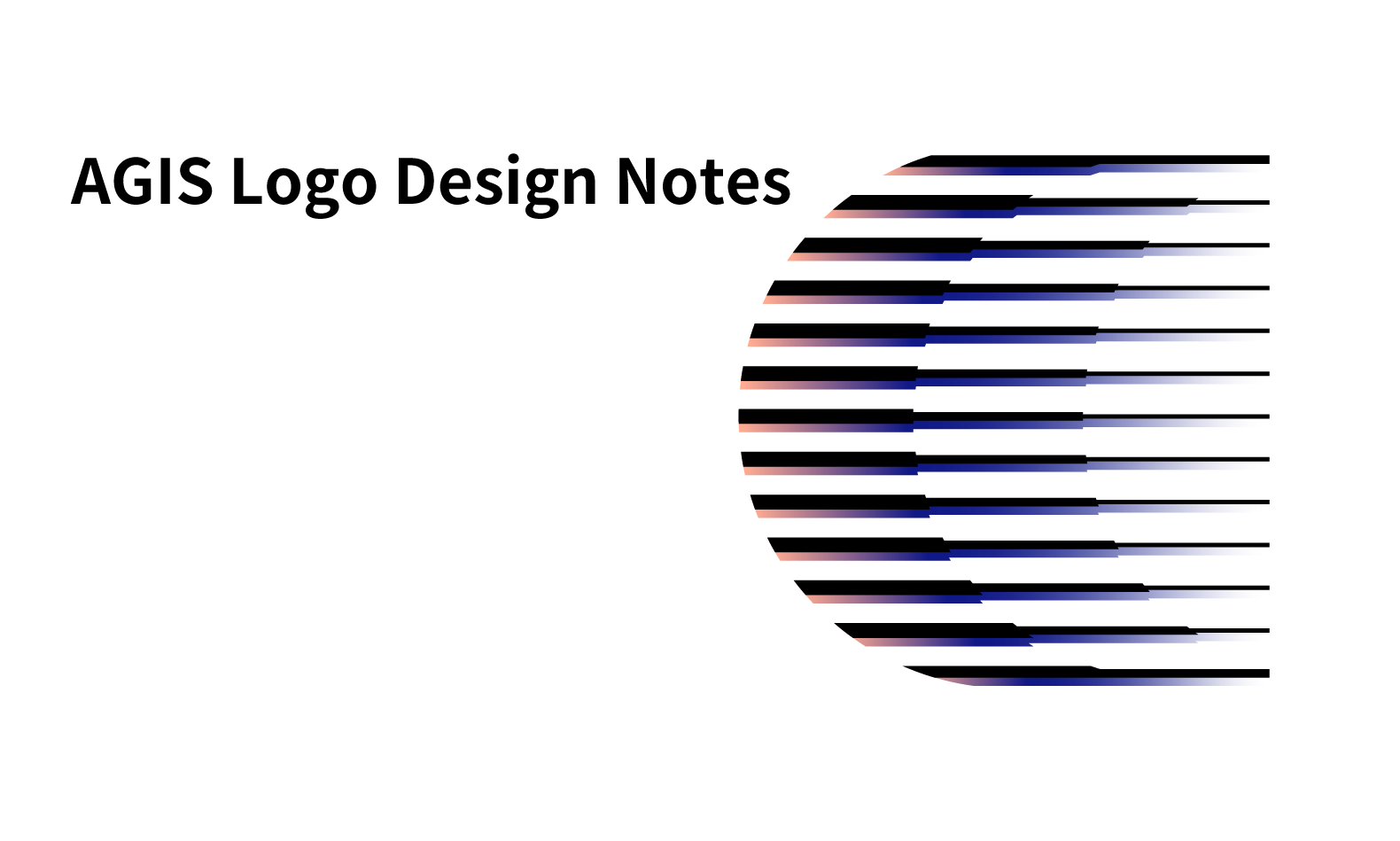
I incorporated an arc motif into the logo and guided the eye towards it, so that although the design remained geometric, modular, and somewhat austere, it would still register first as soft in impression. I also adopted the blue used in the RIKEN logo as the principal color, increasing its affinity with other institutional marks. To preserve reproducibility at small sizes, I adjusted the thickness of the lines across three levels. This helped the design concept, the three levels of shading, remain visible even when the logo was reduced in scale. In this way, it became possible to preserve the concept proposed by AI while arriving at the final logo.*7


What was new in this project, I think, was that the knowledge obtained through interview research with AGIS researchers, and the process of turning that knowledge into language, could be connected directly to the design process itself.
Traditionally, the handling of scientific knowledge and the craft of actually making design have been treated as separate things. In this project, AI made it possible to connect those processes more seamlessly. This may not be something anyone can reproduce at will, so I hesitate to call it a method. But I would be glad if it could stand as an interesting case study for new forms of design in the future.